Linux Books
Thursday, February 23, 2006
Routemaster

 First London AEC Routemaster, RML 2473 (JJD 473D), on route 7 approaching Ladbroke Grove tube station in April 2002.
The AEC Routemaster is a model of double-decker bus that was unveiled in 1954. It was introduced in London on 8 February 1956 and has become one of the famous icons of London. It is still in service on two heritage routes in central London.
Contents
|
History
Design
 A row of Routemaster buses at Acton Depot.
The bus was developed during the period 1947-1956 by a team led by Douglas Scott, the brief being to replace the trolleybuses, which had themselves replaced trams.
Production examples, at first to the 27 feet 6 inches (8.4 metres) length then permitted, were placed in service from 1959 to replace trolleybuses, this process being completed in May 1962. Subsequent Routemasters, the last 500 of which were 30 feet (9.1 metres) long RML types, began the process of replacing the previous generation of RT-type AEC Regent buses (commemorated by Flanders and Swann's "A Transport of Delight") and their similar Leyland Titan RTL and RTW counterparts. The last Routemaster, RML 2760, entered service in March 1968.
The design proved very popular with Londoners and tourists alike. It perpetuated features common to earlier buses: the open platform at the rear, and the presence of a conductor to collect fares, required by the isolated driver's cab. The platform allowed large volumes of passengers to alight and board quickly at stops, and indeed at traffic lights and slow speeds. The conductor collected fares whilst the bus was travelling, which considerably reduced waiting time at stops.
There were some shortcomings in the Routemaster series. Both the standing headroom of the lower floor and the walking headroom on the upper floor (standing is not allowed on the upper deck of UK buses) were problematic. Another shortcoming was inadequate seated passenger leg room. Also, due to the lack of a door at the rear entrance, passengers were not well protected from cold or windy weather.
Withdrawal
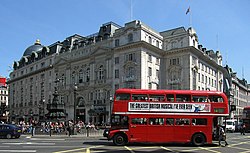 A Routemaster on Route 14 crossing Piccadilly Circus.
Many of London's bus routes switched to modern "one-person operation" (OPO) in the 1970s, out of a desire to reduce operating costs and address staff shortages. However, it has been found that the increased boarding time while each passenger pays the driver slows down busy routes, and leads to "bunching" of buses and poor service. In an attempt to solve this, in central London bus tickets are now bought from street-side machines before boarding. The Oyster card has also made an impact in this regard.
Withdrawal of Routemasters commenced in 1982 but was largely halted by 1988, with comparatively few withdrawn between then and 1992, when a programme was instituted to refurbish 500 of the RML type for ten years' further service. This work, which included updating the interior to modern tastes and re-engining, was carried out by Mainline, TBP and Leaside Buses, and was completed in 1994, in time for the privatisation of London Buses Limited's subsidiaries. This saw the Routemaster fleet divided between nine new companies.
In spite of an earlier public promise to retain the Routemaster, Ken Livingstone, the Mayor of London, later announced the phasing out of the type in order to provide a bus service in the Capital fully accessible to wheelchair users. Government legislation requires full accessibility by 2017 under the Disability Discrimination Act. As a consequence the Routemaster was officially withdrawn from service on 9 December 2005, although it remains in regular service on two heritage routes (see below).
Timetable
 London Central AEC Routemaster RM 758 (re-registered 209 UXJ) on route 36 at Vauxhall bus station, 6 January 2005.
 London Sovereign AEC Routemaster RM 1204 (204 CLT) on route 13 outside Golders Green tube station, 17 October 2005.
Withdrawals commenced on the dates below as the routes' five-year contracts expired.
- Route 15: 29 August 2003
- Route 11: 31 October 2003
- Route 23: 14 November 2003
- Route 94: 23 January 2004
- Route 6: 26 March 2004
- Route 98: 26 March 2004
- Route 8: 4 June 2004
- Route 7: 2 July 2004
- Route 137: 9 July 2004
- Route 9: 3 September 2004
- Route 390: 3 September 2004
- Route 73: 3 September 2004, replaced by bendy buses
- Route 12: 5 November 2004, replaced by bendy buses
- Route 36: 28 January 2005
- Route 19: 1 April 2005
- Route 14: 22 July 2005
- Route 22: 22 July 2005
- Route 13: 21 October 2005
- Route 38: 28 October 2005, replaced by bendy buses
- Route 159: 9 December 2005, departed Marble Arch at 12:10
The 159 route was the final one to be withdrawn, with the exception of the heritage routes.
 RM2217 freshly painted, Arrives at the Garage in Streatham on the 159 for the last time, as thousands of people bring the four lane road to a stand still, Police try to make way, just so it can make the last few yards for the last time. John Hyde, December 9, 2005
 The last three routemasters RM5 (Right), RM6 (Gold/Centre), RM2217 lined up at Brixton Garage minutes after the last run. John Hyde, December 9, 2005
The last day
The routemaster was gradually phased out of service from most of it's routes during 2005. By December only one route remained, 159 from Marble Arch. 8 December 2005 was selected as the final day for "regular service".
Thursday 8 December 2005 was designated the "official" day for commemorating the end of normal scheduled Routemaster operation in London. A large number of preserved RMs and RMLs, plus a number of their predecessors from the "RT" family, made guest appearances on route 159. A huge number of people, not just enthusiasts, took the opportunity to take a ride on one of the buses to say farewell to these famous vehicles.
December 9 started as any other, with Routemasters on the road as normal. From 10am, though, they were replaced at the garage one for one as they arrived back. However around 11.45 more than a dozen routemasters could be counted around Marble Arch. Many were already preserved, with enthusiasts joining the occasion with their own immaculate examples (including RM1000, 2278, 2613, 2715, 2741. 2755 and more). Ominously around noon, there were none. At 12.10 RM54 reached the Marble Arch bus stop and departed, and at 12.18 RM5, gleaming in 1960s style, arrived and went to the bus stop. At this point Oxford St stopped and the police had to contain the crowd. RM6 followed but had to wait nearly 10 minutes for RM5 and the traffic to move. RM6 departed at 12.31 leaving just RM2217 preceded by an open top bus for the press. Meanwhile at 12.49 RM6 was in Piccadilly, and RM5 and RM54 caught up and were swamped by the public on Westminster Bridge, taking 15 minutes to cross. RM6, catching public attention in Golden Jubilee GOLD colours, sailed through Westminster Bridge overtaking RM54 and RM5 to pass school children, thousands in the crowd, and regular people who waved one last time. When RM6 arrived at Streatham Hill at 13.48, thousands of people blocked the four-lane road, bringing all traffic to a stand. As the passengers left the bus, police cleared the roads, and photographers dodged the bus as it slowly moved to the depot. Minutes later the scene was repeated as RM54 arrived, the informed shouting that this actually was not the last one. Preserved Routemasters also passed by adding to the excitement. RM5 came to view complete with a Union Jack in the driver's window, the crowd photographing the bus, the bus driver photographing the crowd. A member of the crowd leaped out and gave flowers to the bus driver as RM5 slid into the depot, as if carried by the crowd. Finally, RM2217, shining like new, dropped her passengers, the crowd shouting to stop. RM2217 took 10 minutes to turn the corner into the depot, as crowds ran behind chasing the bus to the very limits of the garage. The bus left the public highway at 14.07. The crowd took over an hour to leave.
After a short time, RM5 and RM6 slid from the southern exit of the garage and down the street to the LCC Brixton tramways depot, followed a few minutes later by RM2217. The lucky few, and the lucky passersby, were granted an extra chance at a photograph as RM5, RM6 and RM2217 were lined side by side for the press in the quieter surroundings of the old tramways depot, which still had tramlines on the ground. Finally the door was closed and the crowd took the regular less distinctive normal buses back home, leaving the last three alone.
RM54 was purchased from TfL in April 2006 for preservation.
Heritage operation
 A Heritage Routemaster on The Strand, November 2005.
For many people, Routemaster buses evoke nostalgic feelings, and the announcement spawned a campaign to save the bus. Two heritage routes have been introduced to keep the Routemaster alive in London. These use the most recently refurbished Routemaster vehicles and operate on the central London sections of existing regular routes as follows:
- Heritage route 9: Royal Albert Hall — Hyde Park Corner — Piccadilly Circus — Trafalgar Square — Strand — Aldwych. Operated by First Group, this is a short working of existing route 9.
- Heritage route 15: Trafalgar Square — Strand — Aldwych — Fleet Street — Cannon Street — Monument — Tower Hill. Operated by Stagecoach, this is a short working of existing route 15.
Both routes operate every 15 minutes from 0930 to 1830. They are operated under contract to TfL and accept standard Travelcards, Oystercards or cash fares.
Routemasters in service today
 A Routemaster in Montreal, still owned by it's London Operator, Stagecoach and still in daily use on a Heritage role carrying tourists in the city, John Hyde July 2006
Many, if not most major cities in the world will have a Routemaster, or an older RT variant somewhere in it's conurbations. Most Routemasters today are not in regular service, and most that are used are for private hire or very limited tourism use. There are however places where small fleets of Routemasters remain in service on a daily basis.
Some Routemasters can still be seen around London. Less than 20 Routemasters have been retained for use on a tourist service running during daylight hours between some of London's notable landmarks. Regular fares apply, The buses were specially restored for this service and have clean environmental engines and modern electrics and sealed windows. Although open to all passengers the service is more aimed at tourists as a landmark and is not frequented by commuters.
A number of Stagecoach-owned Routemasters have been exported to Montreal, Canada, where Stagecoach now provide a tourist service around the city. This is an unusual case of London Routemasters being operated on a daily service in a foreign country by an original London Routemaster operator.
The older variant RT design buses are used for daily services around Davis, California. Approximately a dozen RTs have provided a daily commuter service around this farm town with services originating at the UC Davis University campus. These buses were purchased directly from London Transport in the early 1980s and have been fitted with natural gas powered engines. Many original features remain.
Manchester, UK operated a number of Routemasters owned by Stagecoach for a short period. The service was found unsuccessful and only operated for a short while after industry deregulation in the early 1990s. These operated services between Piccadilly and Fallowfield.
Trivia
- Northern General and British European Airways also introduced their Routemaster buses in 1960s, many of them were sold to London Transport after withdrawal.
- AEC also built one rear-engined Routemaster for London Transport in mid-1960s.
- Routemasters were used in Manchester during the late-1980s/early-1990s (circa 1988-1993), serving towns between Didsbury and Piccadilly via the Universties and Rusholme.
- Ex-London Routemaster double-decker buses are still running in service in Davis, California, a small college town in Northern California.
See also
- London Buses route 9 (Heritage)
- London Buses route 15 (Heritage)
- Category:London buses
- Category:London bus routes
External links
 Wikimedia Commons has media related to:Category:Routemaster vehicles
- Save the Routemaster
- Routemaster Operators and Owners Association
- The London Bus Page
- Routemaster Bus Tribute Bring back the Routemaster.
- The AEC Society
- AEC Southall
- The London Routemaster Heritage Routes
- Short article on the demise of the Routemaster in London
- The Ensignbus Vintage Bus Museum at Purfleet, Essex
- Replacing the Routemaster: 'How to undo Ken Livingstone’s destruction of London’s best-ever bus' (Think Tank article with contributions from Simon Jenkins, Andrew Gilligan, Zac Goldsmith, Kate Hoey MP and others)
Archives
March 2005 August 2005 January 2006 February 2006 July 2006

